
Istanbul-Bergen declaration on Humanitarian Justice
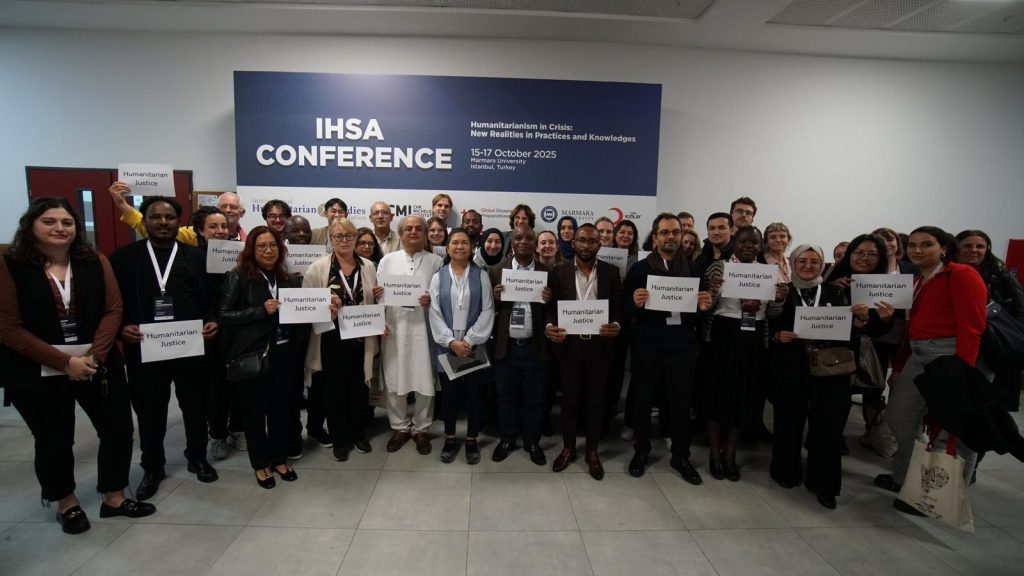
In the lead up to the International Humanitarian Studies Association conference of 2025 in Istanbul and Bergen, and during one of the most turbulent years in humanitarian history, humanitarian observatories in 8 crisis-affected areas: Central and Eastern Europe, Ethiopia, Democratic Republic of Congo, Latin America and the Caribbean, Libya, Namibia, the Philippines, and South Asia engaged in a process to develop a definition and agenda for humanitarian justice.
The Observatories held consultations with affected communities and other stakeholders. These resulted in area-specific reports, that were collectively developed into this declaration, launched in Istanbul on 16 October 2025.
Read the declaration in:
Signatories
The following individuals, communities and organisations have signed the declaration and have consented to their public listing. This list is updated on a weekly basis. Total signatories: 77
Organisations (22)
All India Disaster Mitigation Institute (AIDMI)
Assistance aux groupes sociaux marginalisés (Assist asbl)
Caritas Namibia
Centre for Humanitarian Leadership
CLEO
Clínica Jorge Jaber
Division Provinciale du Genre, Famille et Enfant du Sud -Kivu/RDC
Foundation for Peace and Humanitarian Dialogue
Fundación Halü Bienestar Humano
GESTERRA (Research group on Society, Territory and Resistance in the Amazon – Federal University of Pará (UFPA)- Brazil)
Humanitarian and Development Research Initiative (HADRI), Australia
Interdisciplinary Global Mental Health Innovation
International Humanitarian Studies Association (IHSA)
Jeunes Solutions RDC
L’Observatoire Humanitaire-RDC (Democratic Republic of the Congo)
LOTS Charity Foundation
Migration Consortium Poland
Ornaco (Host organisation for the Kenyan Humanitarian Observatory)
The Hague Humanitarian Studies Centre
The Social Science Centre for African Development-KUTAFIT
Centre d’Appui à la Gouvernance Locale
Samani Ya Mazingira RDC
Communities (17)
Central and Eastern European (CEE) Humanitarian Observatory
Ethiopian Humanitarian Observatory
HOILY (Humanitarian Observatory Initiative Libya)
HOISA (Humanitarian Observatory Initiative South Asia)
Humanitarian Observatory, Ethiopia
Humanitarian Observatory for Policy and Education, Southeast Asia (HOPE SEA)
Humanitarian Observatory, The Netherlands
Humanitarian Observatory, Somalia
Kenyan Humanitarian Observatory
L’Observatoire Humanitaire-RDC (Democratic Republic of the Congo)
Maraka Humanitarian Observatory, Pakistan
Myanmar Humanitarian Observatory
Namibian Humanitarian Observatory
Nigerian Humanitarian Observatory
Observatorio Humanitario de América Latina y el Caribe
Palestinian Humanitarian Observatory
The Philippines Humanitarian Observatory
Individuals (38)
Joanna Dobosz-Dobrowolska
Kubra Mertek Mohamed
Laura-Alina Fabich
Gijs M. van Selm
Cho Cho Winn
Kevin Pulley
Alemayehu B. Hordofa
Hafize Zehra Kavak
Juan Ricardo Aparicio
Mónica Almanza
Juan Pablo Vera
Maria Carinnes Alejandria
Delu Lusambya
Kennedy Oalo
Rodrigo Mena
Tom Ansell
Jakub Kortus
Kristoffer Lidén
Kaira Zoe Alburo-Cañete
Marg Goytom Weldeslassie
Ana Diaz Flores
Valentina Soares
Carolien Jacobs
Isabel Munoz Beaulieu
Rebecca Roberts
Byenda Muziri Jeremie
Patience Mwanuka Masumbuko
Rebecca Bakengane Mukemane
Maria Vukovich
Camila Braga
Andrew Spencer
Adelina Kamal
Patrick Milabyo Kyamusugulwa
Bakengane Mukemane Rebecca
Lisa Schwartz
Mayumi Fuchi
Ghaiath Hussein
Kaan Saner
Methodology
The Istanbul-Bergen Declaration on Humanitarian Justice was developed over a 10 month period, in collaboration with the Humanitarian Observatories and based on participatory fieldwork that took place in 8 contexts: Namibia, Libya, Palestine, the Philippines, Colombia, India, Ethiopia, the Democratic Republic of the Congo, and Ukraine. Initial methodology development took place over the course of a 1-day workshop, attended by The Hague Humanitarian Studies Centre team, and Observatory coordinating teams. Full ethical approval for this process was sought and granted by Erasmus University Rotterdam.
The Humanitarian Observatories in each context then tailored the following methodology to be most appropriate to their context:
1) An open ideation workshop/brainstorm, to map initial key themes, identify FGD participants and questions, and identify context-specific principles
2) Focus Group Discussions with community members: each Observatory coordination team convened two Focus Groups, with 8-10 participants each, to discuss Humanitarian Justice in relation to context. The exact makeup of each Focus Group was slightly different depending on the context, including people from affected communities, people working in local, national, and international humanitarian organisations, people working for rights-based organisations, academics/researchers, community organisation representatives, and so on. In each FGD, invitations were targeted to try and ensure a diversity of life experiences, ages, and viewpoints in the room.
Each Focus Group was facilitated by a member of the Observatory Coordination teams. It was recorded, transcribed, and anonymised.
3) Internal Observatory Workshops: Following the FGDs, 2-hour workshops were held within each Observatory to report back on the findings and conclude the discussions
4) Co-Analysis and Co-Writing: The HSC team and participating Observatory teams engaged in a collaborative process of co-analysis and co-writing. This stage involved synthesizing the findings from the FGDs and workshops, identifying key elements and principles of Humanitarian Justice, and drafting an initial statement
5) Final co-editing of the Istanbul-Bergen Statement: Representatives from all 16 Humanitarian Observatories engaged in a collaborative workshop of around 3.5 hours, where each Observatory presented its feedback on the draft statement, and in some cases proposed alternative framing and/or wording. Proposed alterations were approved by consensus, until a final draft was endorsed by all Observatory Coordination teams
The Humanitarian Observatories are part of the ‘Humanitarian Observatories: Building a Knowledge and Advocacy Network on Humanitarian Governance’ project from February 2025-July 2026. This project has received funding from the European Union under the Horizon ERC Proof of Concept.
Views and opinions expressed are however those of the author(s) only and do not necessarily reflect those of the European Union or European Research Council Executive Agency (ERCEA). Neither the European Union nor the granting authority can be held responsible for them.